
Key takeaways
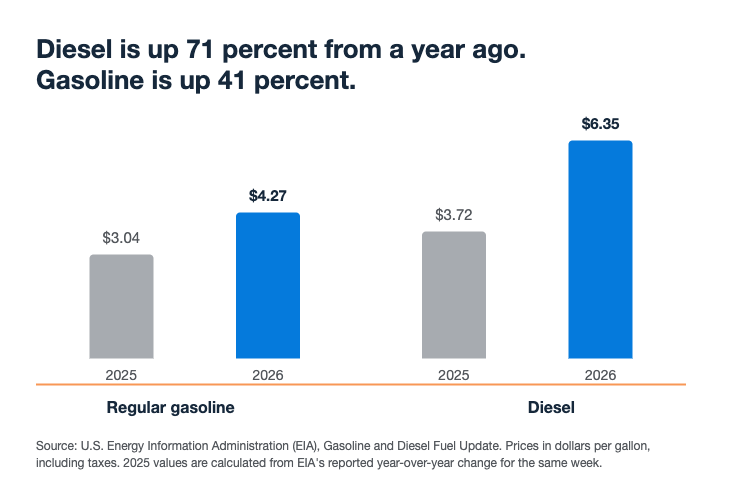
- The U.S. Energy Information Administration (EIA) reported a national average on-highway diesel price of $6.35 a gallon for the week of October 26, 2026, $2.63 above a year earlier.
- Diesel set a record in September, and EIA’s weekly prices have stayed near that level since.
- Fuel is the top concern for trucking, according to the American Transportation Research Institute (ATRI).
- Most near-term savings come from the ICE vehicles you already run: idle control, routing, and right-sizing.
- Hybrid and electric vehicles belong in the plan only where duty cycle and charging support them.
- Measure exposure by account and vehicle group, and build the budget around a price range.
Diesel is up sharply from a year ago
Most fleet budgets assumed diesel would stay in a narrow band, but due to overseas political tensions and constrained supply, fuel has now become an unexpected financial drain for fleets. According to the EIA, on-highway diesel rested at $3.46 a gallon in mid-January 2026, then reached a record high in the week of September 21, and still stayed at $6.35 in late October.
Fuel is also the biggest concern in trucking. ATRI’s 2026 survey of more than 3,000 respondents, conducted from August to October, ranked fuel first by a wide margin. In ATRI’s 2025 cost data, fuel was the second-largest per-mile cost after driver wages. FleetOwner’s Trucking By the Numbers coverage summarizes these figures.
Who feels it first
Work trucks, utility fleets, construction and vocational vehicles, and medium-duty trucks burn far more fuel per mile than light-duty vehicles, and many can’t pass the cost along right away. A utility fleet that budgeted at last year’s prices could be over its fuel line before the second quarter ends. For diesel-heavy operations, fuel surcharges offset part of the increase, but they usually adjust with a delay and don’t apply to every account.
Start by measuring exposure
Before choosing a response, find out how much fuel your fleet uses and where it goes. Start by pulling annual diesel gallons by account or vehicle group, multiply by current prices, and compare the result with your budget. Then run two or three scenarios: prices holding steady, a partial pullback, and another increase. This shows how much variance the budget can absorb, and which accounts need attention first.
Efficiency is the lever you control
Fuel economy has the biggest effect on what each mile costs. ATRI’s 2025 data put the average fleet at 7.43 miles per gallon, and over-the-road trucks in the 30,001 to 40,000 lb operating weight range averaged 6.73. At $6.35 a gallon, fuel alone works out to about 85 cents a mile at 7.43 mpg and about 94 cents at 6.73 mpg. Closing that gap across a fleet can bring back stability in cost and financial planning for your operations.
One easy place to start is vehicle idling, where a diesel engine that runs while parked burns fuel without moving the vehicle. Review your idle policy, and make sure drivers turn on automatic shutdown where the vehicle supports it. You can also use telematics reports to find the units and drivers with the most idle time, and take measures to reduce idling.
Another path for reducing fuel waste is routing, especially when comparing planned routes with actual GPS traces. The gaps in routes usually show detours, backtracking, and congestion the plan didn’t account for. Work with your managers and drivers to find better routes that improve fuel efficiency and reduce time spent not on the job.
To assess your fleet utilization, look at right-sizing your fleet. Check payload and duty cycle data against vehicle specifications, and move units to a smaller or better-configured truck where it makes sense. For more on idling, read the best right-sizing tips from our Fleet Advisory team.
Bring in hybrid and electric where the work fits
Electrification may still be part of the solution for reducing fuel spend, but it isn’t always the first step. A hybrid or electric vehicle makes sense when the duty cycle fits its range and payload, the vehicle has time to charge, and total cost of ownership works over its expected life.
Short routes that return to a depot with time to charge are the best fit. Long-haul work, unpredictable dispatch, and vehicles without dependable charging are usually better served by well-run ICE vehicles for now.
Set the budget around a range
Fuel is usually set once a year, which leaves little room to react. Put a price range into the budget, document the assumptions behind it, and agree in advance on the point at which you’ll change operations or revisit the number. A quarterly check against that range gives leadership time to respond before a variance shows up in the financials.
Where Garage and Otto come in
Your fuel data is likely spread across fuel cards, telematics, dispatch, and vehicle records. Our AI-native fleet management platform Garage™ brings together all of your fleet data and vendors so you can see cost against plan by account, vehicle group, or route. Otto™, the AI assistant in Garage, can answer questions about that data directly, such as which accounts carry the most diesel exposure or which vehicles idle the longest. As an added layer of insight, our fleet team can take your data and give your fleet the best recommended action for optimizing fuel utilization and reducing spend across your fleet.
Sources
- U.S. Energy Information Administration, Gasoline and Diesel Fuel Update (weekly retail diesel and gasoline prices): https://www.eia.gov/petroleum/gasdiesel/
- U.S. Energy Information Administration, Today in Energy: What goes into diesel prices? (September 18, 2026; distillate inventories and record diesel prices): https://www.eia.gov/todayinenergy/detail.php?id=68164
- American Transportation Research Institute, Analysis of the Operational Costs of Trucking: 2026 Update (per-mile costs, fuel economy, industry survey): https://truckingresearch.org/2026/07/analysis-of-the-operational-costs-of-trucking-2026-update/
- FleetOwner, Trucking By the Numbers: Combustion fuel’s explosive prices (November 10, 2026): https://www.fleetowner.com/emissions-efficiency/article/55417694/trucking-by-the-numbers-2026-the-price-of-operating-a-fleet
Frequently asked questions
How high did diesel get in 2026?
EIA’s weekly data shows national average on-highway diesel reached a record in September 2026. It was $6.35 a gallon for the week of October 26, 2026.
What saves money fastest on diesel?
Idle control, routing, and right-sizing. They work on the ICE vehicles you already operate and require little capital.
When does electrification make sense?
When the route fits the vehicle’s range and payload, there’s time to charge, and total cost of ownership works over the vehicle’s life. ATRI data shows battery-electric trucks are still a very small share of the Class 8 population, so most fleets will rely on ICE for now.
How should a budget handle fuel swings?
Plan with a price range rather than a single figure, check spend against it each quarter, and decide in advance when you’ll change operations.
Do surcharges cover the increase?
Often not fully. They usually adjust with a delay and may not apply to every account, so model them separately.
How often should fuel be reviewed?
Quarterly is a reasonable baseline. When prices are moving fast, monthly reviews give you more room to act.